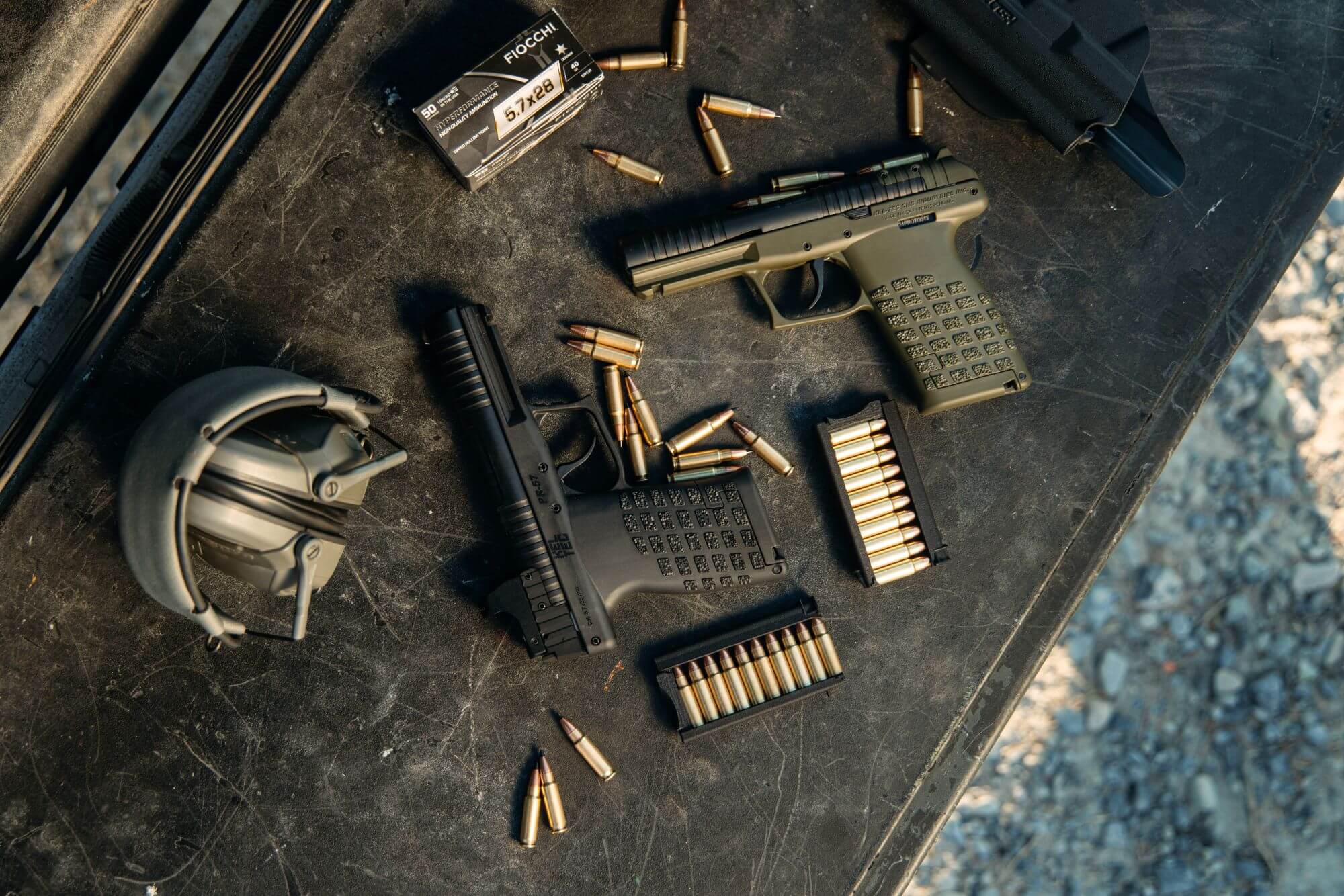
What is 5.7x28mm?
You’ve probably heard someone talking about “five-seven.” Maybe you’ve wondered what the fuss is about, or whether a bottleneck cartridge that looks like a shrunken rifle round belongs in a defensive handgun at all. Those are fair questions, and we want to help you answer them. The 5.7x28mm has one of the more interesting origin stories in modern ammunition, and understanding where it came from goes a long way toward understanding what it can do for you today.
Before we dig into the history, keep a few questions in mind as you read:
- What purpose will a 5.7 firearm serve for you: concealed carry, home defense, or range fun?
- How much do recoil, weight, and capacity matter for that purpose?
- Do you want a true carry-sized handgun, or a larger personal defense platform?
Your answers will point you toward the right firearm by the end of this post.
A Cartridge With a Military History
The story starts in 1989, when NATO put out a request for a cartridge to replace the 9mm in a very specific role. NATO wanted a round with a longer effective range, better accuracy, higher magazine capacity, and the capability to defeat soft body armor and ballistic helmets that were becoming common on the battlefield. The performance bar was steep: the new round had to penetrate a ballistic helmet at 200 meters, and it had to do it from a firearm smaller and lighter than a standard rifle.
FN Herstal of Belgium answered with the 5.7x28mm, a small-caliber, high-velocity cartridge that launches a lightweight .224 caliber bullet at speeds far beyond traditional pistol rounds. FN paired it with a new class of firearm the industry came to call the PDW, or personal defense weapon, a compact platform sized between a pistol and a carbine. The select-fire FN P90 arrived in 1990 and delivered essentially everything NATO had asked for, with the Five-seveN pistol following later that decade. The original armor-piercing load was restricted from civilian sale, but commercial full metal jacket, polymer-tipped, and hollow point loads arrived around 2000, opening the cartridge to the sporting market.
The round found homes with military and law enforcement units around the world, including high-profile protective details that valued its capacity and controllability.
From Niche to Mainstream
Here’s the part of the story many shooters don’t know. For the cartridge’s first three decades, only one company made 5.7 firearms and only one company loaded the ammunition. Both were expensive, and the 5.7 stayed a niche curiosity as a result.
That changed when FN’s patents expired at the end of the 2010s. Starting in late 2019, other manufacturers began chambering pistols in 5.7x28mm at far more accessible prices, and the market responded enthusiastically. We were part of that wave ourselves with our original P50, which fed from the same 50-round magazines the P90 made famous. Two more milestones sealed the cartridge’s mainstream status: NATO formally standardized the 5.7x28mm in 2021, and SAAMI (the American body that standardizes ammunition specifications) approved the cartridge in July 2024. Today, major ammunition makers offer everything from affordable bulk practice loads to purpose-built defensive hollow points and even heavy subsonic loads designed for suppressed shooting. Prices have come down considerably, and availability has never been better.
Why Shooters Love the 5.7
So what does a shooter actually get from this cartridge? Quite a lot, as it turns out.
The 5.7x28mm delivers near-rifle velocity, flat trajectory, exceptional capacity, and roughly a third less recoil than 9mm in a lightweight package.
Speed and trajectory. The 5.7 moves at roughly twice the velocity of a 9mm. Most loads leave a pistol-length barrel at around 1,600 to 1,800 feet per second, and longer barrels push common loads past 2,200 feet per second. That speed translates to a flat trajectory, which makes hitting at distance noticeably easier than with slower, heavier rounds.
Soft recoil, real energy. Independent testing has consistently found the 5.7’s felt recoil lands between a .22 Magnum and a 9mm, producing roughly a third less recoil than 9mm while delivering muzzle energy that reaches into the lower end of the 9mm’s range. That combination is rare. Most low-recoil cartridges give up substantial energy to get there; the 5.7 gives up far less. For shooters who find 9mm uncomfortable due to hand strength, age, or injury, this is one of the most capable soft-shooting centerfire options available. And because it’s a centerfire cartridge, it offers more reliable ignition than rimfire alternatives like .22 LR and .22 Magnum.
Capacity and weight. The long, skinny case means 5.7 pistol capacities start at 20 rounds and go up from there, and the ammunition itself is light. You can carry a lot of rounds without much bulk or weight, which is exactly the trait that made the cartridge famous in the PDW role.
Barrier behavior. One reason some law enforcement agencies adopted the 5.7 for indoor and crowded-environment roles is how the light, fast bullets behave against hard barriers. In testing, common commercial loads tend to fragment or break apart when they strike materials like drywall, which reduces (though never eliminates) overpenetration risk compared to heavier, slower projectiles. Meanwhile, independent ballistic gel testing has shown that quality 5.7 defensive hollow points typically reach recognized penetration depths in test media, with velocity driving reliable expansion. As always, defensive performance depends on ammunition selection, shot placement, and training, and no caliber is a magic solution. But the 5.7 has earned serious consideration on the merits.
The Barrel Length Question
There’s one real caveat worth understanding, and it happens to explain why we build our 5.7 lineup the way we do. This high-pressure cartridge rewards barrel length. Its light bullets depend on velocity to perform, and longer barrels deliver more of it. Historically, that meant 5.7 pistols were full-size only, comfortable at the range and great for home defense, but a genuine challenge to conceal. Shooters loved the cartridge and wished for two things: a platform that maximized its velocity potential, and a pistol small enough to actually carry. We built both.
Find the Right 5.7 for You
We now make two very different 5.7x28mm firearms, and the right one comes down to the purpose you identified at the start.
For carry: the PR-5.7
The old complaint that 5.7 pistols are too big to conceal is exactly the problem the KelTec PR-5.7 compact 5.7 pistol was engineered to solve. At just 13.86 ounces unloaded and under an inch at its widest point, it’s the lightest 5.7mm pistol on the market, nearly 40% lighter than the next lightest option. Its rotary barrel design tames the cartridge’s high pressure while keeping the pistol slim, and its top-loading fixed magazine holds 20+1 rounds right in the grip, loaded quickly with the included 10-round stripper clips. For shooters who want the cartridge’s capacity and soft recoil in a5.7 carry pistol that disappears in a holster, it’s a genuine first of its kind.
For the home and the range: the KP50
If your purpose leans toward home defense or range versatility, the cartridge’s love of barrel length works in your favor with the KelTec KP50, our 5.7 PDW platform. Its 9.6 inch barrel wrings out far more velocity than any carry-sized pistol can, putting common loads much closer to the cartridge’s full potential. It carries 50 rounds in a bottom-insert, drop-free magazine, with an optional Jungle Clip that pairs two magazines for 100 rounds on board. The 1/2x28mm threaded barrel also makes this 5.7 carbine-style pistol a natural host for a suppressor, and with heavy subsonic 5.7 loads now on the market, a suppressed KP50 is a remarkably quiet package. Add the rear Picatinny rail and side-folding brace option, and you get rifle-like capability that folds down to 18.6 inches.
A quick note on classification, because it matters. The KP50 is legally a pistol. Adding a shoulder stock to a firearm with a barrel this short creates a short-barreled rifle (SBR) under federal law, which requires registration through the ATF before you can configure it that way. Many owners choose to go through that process, and the federal making tax on approved applications has recently been reduced to zero, though requirements and state laws vary and change. We also offer a factory KP50 SBR configuration with a side-folding stock for buyers who complete the federal process, and a select-fire MP50 variant, essentially a 5.7 submachine gun, built exclusively for military and law enforcement. Before pursuing an SBR or any regulated configuration, verify current federal and state law where you live, because we can’t tell you what’s legal in your jurisdiction and the rules genuinely do change.
You can explore our full lineup of pistols,rifles, andshotguns, and when you’re ready to handle one in person, our retailer locator will point you to a dealer near you.
Own It Responsibly
The 5.7x28mm spent thirty years as a niche cartridge and became mainstream almost overnight, and the reasons are easy to understand once you know the story: it’s fast, flat, soft-shooting, officially standardized, and now affordable to feed. Whether that leads you to a slim carry pistol or a 50-round PDW, we want you to make the right choice for your needs, not just the newest thing on the shelf.
Whichever way you go, treat every firearm as if it’s loaded, store it securely and away from unauthorized hands, and spend time with an experienced instructor before you rely on any gun for defense. Owner’s manuals and support resources for every KelTec firearm are always available at our support center. Train often, stay safe, and enjoy everything this remarkable little cartridge has to offer.